
Cellular Coverage – Making Choices for In-building
Cellular Coverage – Making Choices for In-building
Todd Landry
June 9, 2026
Cellular and IT systems are indeed complex, it’s the capabilities of the provider delivering them that make it simple, easy, and fast. Choose wisely. Cellular and IT systems are indeed complex, it’s the capabilities of the provider delivering them that make it simple, easy, and fast. Choose wisely.Cellular and IT systems are indeed complex, it’s the capabilities of the provider delivering them that make it simple, easy, and fast. Choose wisely.
To pitch their offerings, you will read posts that suggest a DAS cellular system for your building is very complex, has complex and risky carrier coordination, and takes more than a year to get deployed (an average of 64 weeks one post suggests) – malarkey!
The intelligent reader will see through these types of pitches quickly, I have seen real DAS projects for three carriers go from project start to live within 8 weeks. The reality is that any cellular RF project for indoor is complex, but what matters is a provider that has the expertiseand the resources to make it seem easy and make it move quickly.
Too many providers pitch their ability to deliver DAS, only to fall short on design resources, a true understanding of carrier design standards, carrier relationships and coordination, and the disciplined life cycle planning to execute from start to finish. Whether the RF design is for licensed spectrum or shared spectrum like CBRS, you cannot skip the RF design process – and any provider that suggests otherwise you should run from fast.
Is the CBRS and MOCN a Good Choice?
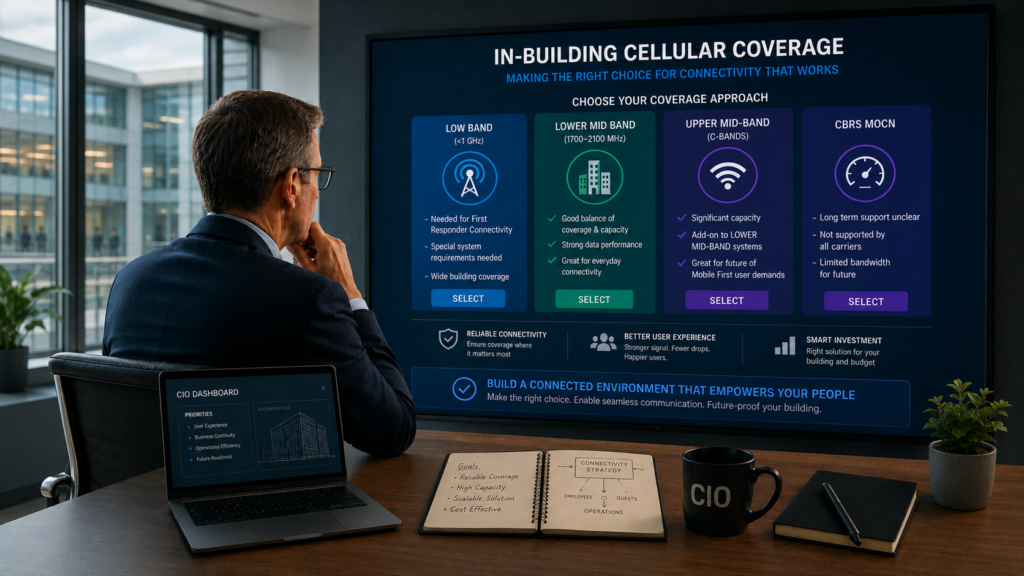
CBRS spectrum authorized by the FCC in 2020 has been searching for broad industry adoption and success since. Its ultimate focus has been on cellular private networks and when the requirements require cellular protocol benefits it is perfect for this. As mobile phones supported this spectrum an add-on capability known as Multiple Operator Core Connect (MOCN) allowed mobile phones with carrier SIMs to handover to systems with CBRS.
This approach is sound functionally and technically; however, the real issue is that 2 of the 3 carriers do not have clear commercial processes for connecting CBRS to their networks, rendering it useful if you need 1 (AT&T) and risky at best if you need multi-carrier. While some will tout that all three carriers will join, you will find many early providers of this has discontinued their focus on their offering or have even gone out of business – which should create an immediate red-flag for anyone considering it.
Is DAS Still a Good Choice?
DAS systems are well known, are proven coverage solutions, and there are multiple firms with expertise in the industry. A good DAS provider can assess a building for its current state (think of it as an MRI for the building), design to carrier mandated requirements, coordinate with carriers and include carrier signal processing, testing and operations.
Carriers are aware and fully support the use of DAS systems for in-building coverage. In 2022 both AT&T and Verizon brought their C-Band spectrum to market, T-Mobile had already brought their N41 band to market in 2020. This combination of spectrum across the three carriers sums up to some 550MHz of spectrum, increasing the end user throughput spectrum by 8-10 times that of historical spectrum options used for indoors. Moreover, this is some 7 times the capacity of the useable CBRS spectrum for indoors.
New solutions have also entered the market, such as Ericsson’s Radio DOT system, which also support the wide bands and have an option to add CBRS spectrum to it. The radio DOT system will be found as more IT-friendly, with its Category POE cabling and Access Point-like radio elements.
Is One More Complex?
Any form of cellular coverage solution should be considered complex, regardless of spectrum. No differently, a CBRS network is a cellular indoor network, its design, equipment, testing, and operations is arguably more so than DAS as it requires much deeper knowledge of cellular baseband and MOCN gateway functions and required tunnel networking with carriers. Again, this is all dependent on the provider selected and the best advice it to be very diligent in testing a prospective providers knowledge across all the functions required to design, deliver, and support you.
Important Take Aways
Study the real details behind these offerings and what they might mean for your in-building mobile use near term and long term. The demand for highly reliable and supportable solutions for 5G and upcoming 6G are important, and you don’t have to look too far to see what the carriers are going to focus on. Lastly, don’t be fooled by finger pointing on complexity and time to deliver messages – all wireless systems are complex and require a very capable partner to deliver.
Choose wisely, Choose smartly.