Venue Wireless RETHINK — Season 1 : Episode 3 – Rethink Partner Selection
Venue Wireless RETHINK — Season 1 : Episode 3 – Rethink Partner Selection
Todd Landry
August 20, 2026
On June 29th, 2026, at the annual Sports & Entertainment Alliance for Technology (SEAT) Conference I presented to a cross section of this industry, including sports clubs, solutions providers, 3PO’s, wireless carriers, and sports venue consultants. The session was titled Venue Wireless RETHINK – a MASTERCLASS. While many of these topics could be controversial among different attendees, I was pleasantly surprised to see a cross-section of this industry response very positively and join in the idea that it is time for a rethink in this industry and the approach to selecting and delivering cellular wireless infrastructure.
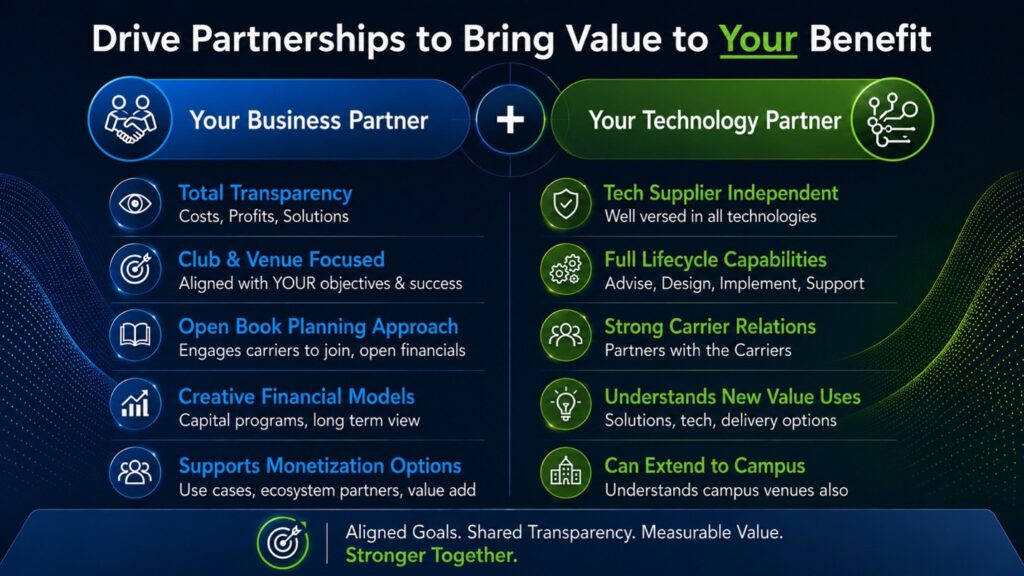
To fundamentally change the model and engage the carriers in a new manner, it is critical to shift toward partners that bring several key characteristics to the table. Your strategy needs to ensure that a partner has the expertise, vision, and understanding of the technology and business models to help you across several key aspects. The following chart provides an outline of these key characteristics to consider.
Open Books
As the financial models change, so should the capabilities of your partner. In this changing world, the more beneficial way to engage carriers, implementers, and equipment suppliers is through an open-book approach. This provides more transparency across constituencies, ensures each party is “whole,” and builds the trust needed to reach the venue’s goals. This approach also engages carriers more openly, and carriers have already indicated their receptiveness to this model.
Technical Industry Alignment
Choosing a partner that also has the technical depth to understand the state of the market is a key element, as venues are long-term investments and projects are often several years in the planning. The good ole’ Wayne Gretzky once said, “Skate to where the puck is going to be.” Making this part of the planning process is an important requirement every venue should have.
Unfortunately, every supplier in this business isn’t so savvy about the state of the technology and how to align it with your venue’s opening. Far too many are proposing technologies and approaches that will be out of date by the time you open!
Partner Credentials
Another key aspect is choosing a partner that can design, deploy, and support the system. Even if they don’t do all of it themselves—and most should be capable of subcontracting certain aspects—the important message here is: “THOSE THAT DO, KNOW.”
If your partner does not have direct experience with these systems, along with teams that execute on designs, construction, system support, and daily engagement with the carriers, they are likely out of touch.
Rethink Partnerships – Think Micro-Branding
Too often, partners are selected not for their ability to plan and deliver the best outcomes for fans and the venue, but for their willingness to offer a large sponsorship check. That may benefit the partnerships team, but does it serve the venue as a whole?
The good news is that, with so much emerging digital data and engagement, there are many ways to bring brands to fans. Even better, there are inherent methods to better measure the conversion and impact of that brand representation.
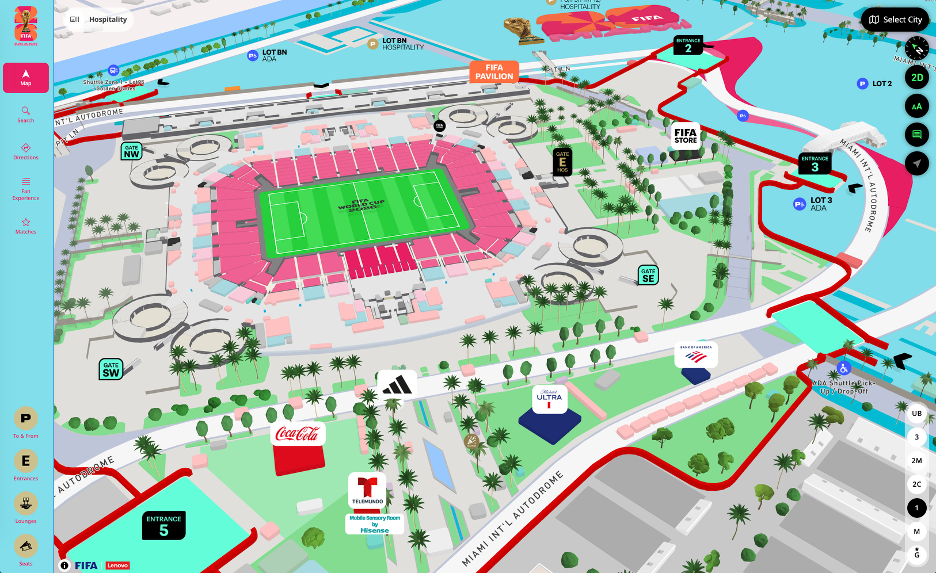
A great example, and one I shared at the SEAT session, is from an organization known as PAM. Its 3D wayfinding and engagement platform is fantastic. But, as it relates to branding, look at the ability in the attached image to bring brands directly to mobile eyeballs. I referred to this as “micro-branding.”
While this isn’t entirely new, I believe there is an emerging intersection of data from the mobile infrastructure that can drive smarter mobile brand engagements in real time, with real traceability.
That’s all I’ll say on this for now. A special thanks and shoutout to the PAM team for the images. Note that this was related to the FIFA World Cup 2026, and a snapshot of engagement across venues and platforms illustrated some 693,000 users!
More Than Mobile Coverage
Historically, the drivers behind this business have been solely focused on connecting mobile phones to their carrier networks. As the demand for more connected devices that are not mobile phones increases—and as the number of devices with native cellular connectivity grows—so does the opportunity to think differently about your infrastructure.
What are these things? They include portable POS handsets and terminals, broadcast cameras (yes, they can use cellular), dedicated operations and safety communications handsets, sensor devices that enhance venue operational intelligence, and much more.
As a result, it is critical to begin thinking of this infrastructure as a Digital Services Platform—one that can mobilize your venue operations and, if packaged correctly, could even create new revenue streams.
A Simple Four-Point Approach
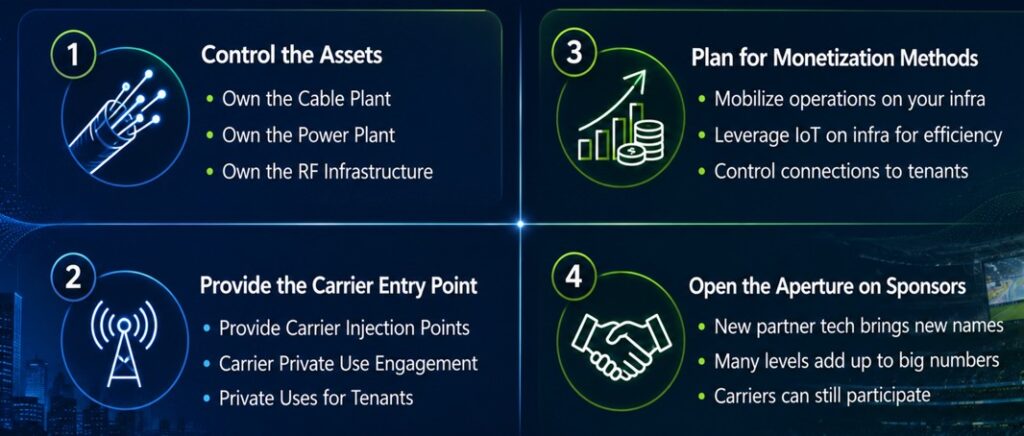
Perhaps a simple way to think about planning your cellular infrastructure, at a high level, is to structure the planning around four main points:
1) Fund and Control: Fund and control as much of the assets as possible and, as part of that plan, define your own use of these assets. With private uses looming as a highly efficient method for operations and fan engagement, this is a smart move.
2) Enable Carrier Participation: Provide the areas where carriers can easily and cost-effectively join the system to distribute their services. There is still an opportunity here for carriers to fund some of the source equipment.
3) Build for Additional Services: Build a plan for the services you can add to this infrastructure, with a clear view of those that create efficiency, deliver new experiences, or can be offered as a service to generate revenue.
4) Turn Technology into a Sponsorship Engine: take a broader view on your sponsorships and treat your technology as a sponsorship engine – Take a broader view of your sponsorships and treat your technology as a sponsorship engine—finding new mobile technologies that engage fans both in and out of the venue with content that is ripe for brand integration.
Watch for Episode 4 to Learn About the OEM SUPPLIER SHAKE UP